
Real ROI Timelines for Plastic Surgery Practices I got on a call with a plastic surgeon who was incredibly frustrated with her marketing team. She spent north of $50,000 between paid ads and SEO and got three consultations.THREE. No revenue generated. Zero. Her agency kept telling her to “give it more time” and “trust the …


Real ROI Timelines for Plastic Surgery Practices
I got on a call with a plastic surgeon who was incredibly frustrated with her marketing team.
She spent north of $50,000 between paid ads and SEO and got three consultations.
THREE.
No revenue generated. Zero.
Her agency kept telling her to “give it more time” and “trust the process.”
Keep in mind, their annual contract was about to renew and they had promised the world to her.
Needless to say, they did not deliver.
So she asked me the question every practice owner wants answered:
“How long do your marketing efforts take to work?”
And you know what?
That is a completely reasonable question to ask.
If you are spending tens of thousands of dollars on healthcare digital marketing, you deserve at least a realistic timeline for when results should start coming in. The problem is most agencies will never give you one.
They hide behind vague phrases like “it takes time” or “every practice is different” because they do not want to be held accountable or they have never produced consistent results themselves. This is one of the most common healthcare marketing mistakes I see.
After 8+ years of working exclusively with aesthetic practices and managing over $5 million in ad spend, I am going to give you an honest answer based on how long it actually takes our clients to see profitable results.
Here is how long marketing really takes to generate ROI and what makes it faster or slower for your specific situation.
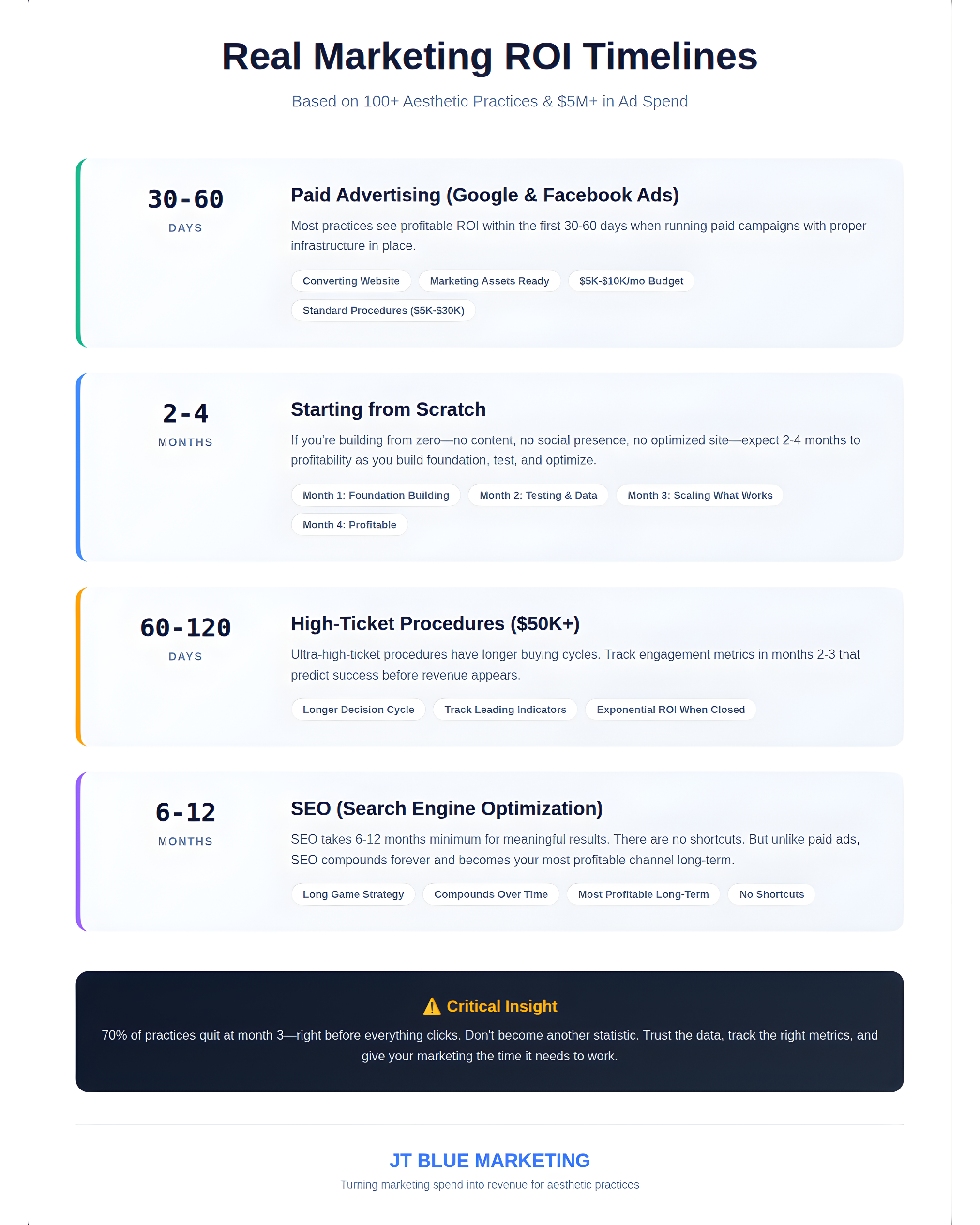
Paid Ads ROI Timeline for Plastic Surgery Practices (30-60 Days)
Let me start with the good news.
Most of my plastic surgery and medical spa clients see a profitable ROI within 30-60 days when we are running paid advertising campaigns.
I am talking about Google Ads healthcare campaigns and Facebook or Instagram ads generating consultations that turn into booked procedures within the first two months.
However, this only happens when five specific conditions are met.
What Needs to Be in Place for Paid Ads to Work
- You have a conversion optimized website or landing page.
- You have marketing assets we can use, such as educational videos and trust building content.
- You have an active social presence, even if your following is small.
- You have a realistic budget, not $500 expecting $50,000.
- You are offering procedures in the $1,000 to $10,000 range.
From there, we refine the style, tone, and cadence of the content so it speaks directly to the person behind those searches.
This allows our clients to show up consistently on TikTok and Instagram when someone searches for information related to a specific procedure, not just in Google but across platforms.
Instead of copy-and-pasting hashtags like it is 2016, we create content that signals relevance and intent. Content that says, “this is for you.”
This is how our clients dominate social visibility before we spend a single dollar on ads.
When all of those boxes are checked, I have seen clients book up to 25 qualified consultations in their first 30 days.
But those pieces need to be in place first.
If they are not, we focus on fixing the foundation before expecting consistent ROI. This is where many practices unknowingly increase their patient acquisition cost.
Which brings me to the next phase.
The 2-4 Month ROI Timeline When Starting From Scratch
If you are starting from scratch with no content, no active social media, and an outdated website, then 2-4 months to profitability is far more realistic.
Is it still possible to see results in the first 30 days?
Yes, we have seen it happen.
But having a strong foundation makes business growth more predictable and sustainable.
People who click on your ads will also visit your website, watch your videos, and check your social media. They want to learn more about you and choose someone they trust. This is a critical part of any effective medical marketing funnel.
If those assets are not available, we start there.
It Strengthens the Patient Journey
Patients rarely convert after a single interaction. Nurturing ensures they receive helpful guidance at every stage of the medical marketing funnel, from awareness to appointment booking.
It Improves Patient Engagement
A thoughtful patient engagement strategy keeps your practice top of mind while reinforcing expertise and approachability.
It Increases Marketing Efficiency
Nurtured leads are more likely to convert, which improves ROI and reduces wasted ad spend.
A Realistic Month-by-Month Breakdown
Month 1: Building the Foundation
We focus on creating content, setting up campaigns, developing assets, and optimizing your website for conversions. Consultations can come in, but setup is the priority.
Month 2: Testing and Optimization
We test what works. Which ad creatives convert? Which audiences respond? What does your cost per lead and consultation look like? This is where data guides decisions.
Month 3: Momentum Starts
Qualified leads are coming in and consultations begin showing up on your calendar consistently.
Month 4: Profitability and Scaling
You are profitable and we begin scaling for better returns.
This is a common pattern we see with our clients, but there are no guarantees.
The same general timeline applies if you are working with a smaller budget of $1,000 to $3,000 per month. We cannot dominate Google Ads or Meta at that level, so we test carefully, optimize strategically, and scale as results improve.
High-Ticket Procedure Marketing Timelines (60-120 Days)
Now let us talk about the elephant in the room: ultra high-ticket procedures.
If you are advertising $50,000 facelifts, $75,000 mommy makeovers, or $100,000 face and body transformations, your timeline will be longer.
I have worked with surgeons who specialize in $100,000 deep plane facelift procedures. In the first 90 days, one client booked exactly one consultation.
He was understandably anxious.
But the data told a different story. People were engaging with his content, visiting the website multiple times, and submitting “learn more” forms. The buying cycle was simply longer due to the price point and the trust required.
By day 120, that same client was booking over $100,000 in procedures.
High-ticket patients take longer to convert, but when they do, the ROI can be significant and momentum continues to build.
Medical SEO Timeline (6-12 Months Minimum)
Here is the part most people do not want to hear.
If an agency promises medical SEO results in 60 to 90 days, they are not being honest.
Healthcare SEO takes 6-12 months minimum, sometimes longer depending on your market and competition.
I know that is frustrating. Everyone wants faster results. But SEO is a long-term strategy.
The upside is that once it works, it compounds.
Paid ads stop the moment you stop paying. SEO continues working.
After 6 to 18 months of consistent SEO, we have had clients generate 40 to 80 percent of new patient volume from organic search, with no ongoing ad spend because the investment pays for itself.
But you have to commit to the timeline.
TL;DR: How Long Does Healthcare Marketing Take to Work?
Here is the honest breakdown based on real client results:
- Paid ads with the right foundation: 30-60 days
- Starting from scratch or limited budget: 2-4 months
- Ultra high-ticket procedures ($50,000+): 60-120 days
- Medical SEO: 6-12 months minimum
The biggest mistake is giving up too early.
If you have been burned by agencies that overpromised and underdelivered, I understand. That is why I am upfront about timelines so nothing comes as a surprise.
No two aesthetic practices are the same. Your timeline depends on your procedures, budget, market competitiveness, existing assets, patient demographics, and willingness to work with us.
But now you know what is realistic and what is not.
If you are a plastic surgeon, medical spa owner, or aesthetic practice owner trying to figure out what timeline makes sense for your practice, send me a DM. I will give you a realistic timeline assessment for free.
Or visit https://jtbluemarketing.co/ to see how we have helped over 100 aesthetic practices generate predictable patient flow.
Audience Segmentation
Not all leads have the same needs. Segmenting allows you to personalize communication based on factors such as:
- Service or treatment interest
- Engagement behavior
- Patient demographics
Automated Email Campaigns
Email automation allows consistent follow-up without overwhelming staff. Effective campaigns often include:
- Welcome sequences
- Educational drip content
- Appointment reminders
Educational Content Creation
High-quality content supports both nurturing and credibility. Common formats include:
- Blog articles
- FAQs and guides
- Short videos explaining procedures
Content should align with each stage of the medical marketing funnel.
Patient Engagement Strategy Integration
A strong patient engagement strategy extends beyond marketing by encouraging two-way communication. This may involve:
- SMS reminders
- Post-visit follow-ups
- Feedback surveys
Multichannel Communication
Patients engage differently. Combining multiple channels ensures better reach:
- Text messaging
- Social media
- Phone outreach
Frequently Asked Questions
What factors cause marketing timelines to take longer than expected?
Marketing timelines often extend when foundational issues exist, such as unclear messaging, weak differentiation, or inconsistent branding. Delays can also occur when patient decision cycles are longer than anticipated or when tracking systems are not properly set up to measure progress.
How does consultation follow up affect marketing ROI timelines?
Slow response times and inconsistent follow up can delay results even when marketing is working. Practices that respond quickly and guide patients clearly through the consultation process tend to see faster returns from the same marketing efforts.
Can a low website conversion rate slow down marketing results?
Yes. Traffic alone does not drive ROI. If visitors struggle to understand services, pricing expectations, or next steps, conversions drop and timelines stretch. Improving clarity and usability often accelerates results without increasing spend.
Does online reputation impact how fast marketing starts working?
Online reviews and overall reputation influence patient trust before they ever book a consultation. A weaker reputation can lengthen the decision process, while strong reviews and social proof can shorten the path to conversion.
How long should a practice wait before deciding marketing is not working?
Practices should evaluate performance based on data trends rather than emotion. If key indicators show no improvement after proper testing, optimization, and follow through, it may be time to reassess strategy rather than continue waiting without adjustments.

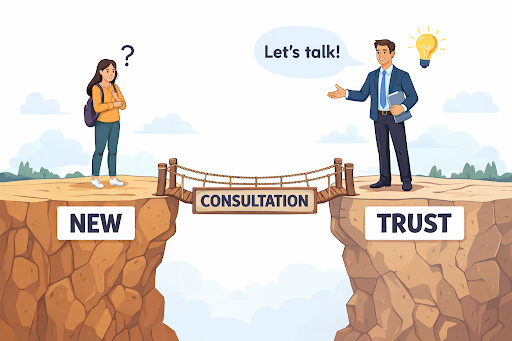
Let’s Talk About Your Growth
Contact us for a free consultation and let’s build a custom healthcare marketing strategy that fits your practice.
Book a Consultation
It’s easy and free!
Tags:Template2

Josh Torres
CEO & Founder, JT Blue Marketing
With a proven track record of generating millions in revenue for clients, he focuses on strategies that deliver ROI and position practices as industry leaders. His approach is clear, data-driven, and tailored to each practice’s unique goals.