
When it comes to hair transplant marketing, most agencies get it completely wrong because they don't understand who they're actually talking to. Hair loss touches a persons confidence, their identity, and self-image in ways that other aesthetic procedures don't. And yet, most of the hair restoration marketing agencies treats it like it's no different from …


When it comes to hair transplant marketing, most agencies get it completely wrong because they don’t understand who they’re actually talking to. Hair loss touches a persons confidence, their identity, and self-image in ways that other aesthetic procedures don’t. And yet, most of the hair restoration marketing agencies treats it like it’s no different from advertising a gym membership.
Many hair transplant marketing agencies run generic Facebook and Instagram ad campaigns, stuff keywords into thin blog posts, and send the same templated monthly reports regardless of results, and wonder why their strategy aren’t working. They don’t know how to speak to that core audience to attract more consultations and what it takes to convert them.
So clinics end up spending $3,000–$10,000 a month on all sorts of marketing efforts that don’t turn into booked appointments. That’s not a budget or platform problem. That’s a strategy problem.
At JT Blue Marketing, we’ve managed over $10 million in ad spend across 100+ aesthetic practices, including hair restoration clinics, facial plastic surgeons, dentists, and medical spas. So on this guide I’ll break down exactly what’s working in 2026, what’s quietly burning through your hair restoration advertising budget, and how to build a patient acquisition system that actually fills your schedule with people interested in your services.
Why hair restoration marketing is different from general aesthetic marketing
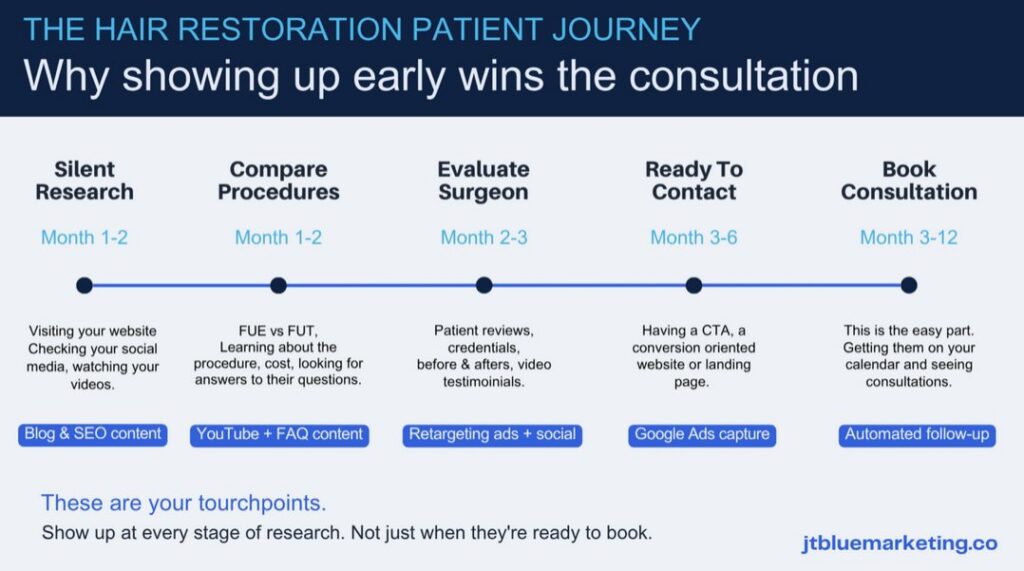
Hair restoration patients do more research than almost any other aesthetic patient. A rhinoplasty patient might deliberate from choosing a facial plastic surgeon for six months, but many hair transplant marketing patients are often researching for a year or longer. They do so quietly, privately, usually on their phone. They’re price-comparing across FUE, FUT, PRP, and other non-surgical options. They’re reading forum posts, watching YouTube procedure videos, and studying surgeon reviews with the level of scrutiny most people reserve for major surgery.
That research window is the entire game. The practices that win are the ones showing up with the right content while they’re doing their research. Not just showing up with a Google ad (great for warm audiences btw) when someone’s ready to book, but being positioned with educational and authoritative touchpoints months before they ever fill out a form. As you can imagine, your content and showing up at the right time plays a huge role in their decision making. So let’s make sure you’ve covered in all fronts.
The 4-channel hair transplant marketing agency patient acquisition system
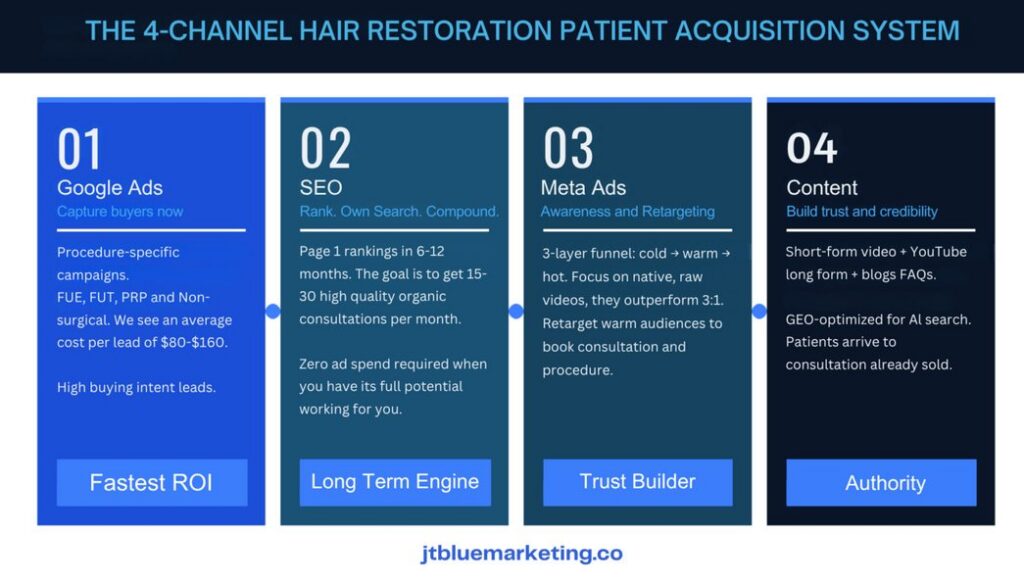
1. Google Ads. Capturing patients already in buying mode.
When someone types “FUE hair transplant near me” or “best hair restoration clinic in [city],” they’re not simply browsing, they’re evaluating providers. Google Ads for hair transplant is the highest-ROI channel for hair transplant surgeon marketing specifically because it intercepts patients in the decision phase after the’ve done their research, when they’re ready to contact someone.
The structural mistake most clinics make is running a single broad “hair restoration” campaign. For procedure specific campaigns, you want to separate them for FUE, FUT, PRP therapy, and non-surgical options to generate a dramatically lower cost-per-lead while keeping buyer intent high. Because the ad copy, landing page, and patient intent all align, it will resonate better with the person looking for a specific procedure when you set up campaigns this way. Having a well structured hair restoration google ads account in a competitive market should be generating qualified leads at $80–$160 CPL. Above that, there’s may be other factors that need evaluating.
With our clients, we’ve been able to consistently attract high quality hair restoration leads that fill their calendar with high intent buyers, all because of our proven strategy.
One important caveat to note, google flags certain hair restoration claims as speculative or unverified. Working with an agency that understands hair restoration advertising compliance is the difference between a campaign that launches in 48 hours and one that spends three weeks in disapproval loops and never delivering the results you want. Choose your marketing partners wisely.
2. Hair Restoration SEO. The channel that pays you back for years.
Ranking on page one for specific keywords such as “hair transplant [city]” takes on average 6–12 months of consistent SEO work, depending on your current keyword ranking. But once you’re there, organic traffic costs you nothing per click, and a hair restoration clinic ranking for three to five high-intent local terms can generate 15–30 inbound consultation requests per month without any ongoing ad spend. This is the goal we look to achieve with hair transplant SEO.
Now, content strategy matters as much as technical SEO. Hair restoration clients research extensively before calling your office. They want to understand the difference between FUE and FUT, realistic cost ranges, recovery timelines, and how to evaluate a surgeon’s credentials. This is where you can differentiate yourself. For our clients, we create content through blogs, improve their existing pages, social media videos and ads and AI optimized content, that builds trust and credibility. The goal of the content is to answer these questions while positioning you as the authority figure in their eyes. So when they continuously come across your content through all platforms, that authority translates into booked patients and a full calendar.
We have also seen the the advent of SEO and GEO — Generative Engine Optimization — work together. People are increasingly using AI tools like ChatGPT, Perplexity, and Google’s AI Overview to research procedures before ever visiting a website. The customer journey is starting in these AI platforms, which means we also have to optimize for that if we want to stay relevant and top of mind. FAQ-structured content, schema markup and having good hair transplant SEO fundamentals, is most likely to get cited in AI generated responses. And the great news is this is an emerging patient acquisition channel that no competitor in your market is optimizing for yet.
3. Meta ads. Awareness and retargeting for trust building.
Facebook and Instagram ads work differently for hair restoration than they do for injectable treatments or body contouring. People are bombarded with ads constantly while they’re scrolling, and you’re interrupting. That means your opening hook and your creative must be good enough to stop the scroll.
Nowadays, people engage most with and prefer the raw and engaging content. Not the production, cinematic and branded videos that we used to see years back. The content that consistently outperforms are the patient journey video (before, during, and after), FAQ’s and addressing people’s concerns (“Will it look natural? How painful is recovery?”), and authentic behind the scenes content that builds familiarity. So its time to pull out the iPhone and hit that record button.
When it comes to retargeting, that’s the low hanging fruit of marketing. That’s where Meta’s real power comes into play. They have some of the best retargeting options if you know what you’re doing. For example, someone who watched 50% of your video, visited your procedures page, or engaged with your Instagram content in the last 90 days is dramatically more likely to convert than a cold audience. That’s who we want to retargeting with strategic videos which lead them to scheduling a consultation. We’ve even built a proven three layer funnel, cold awareness, warm video retargeting, hot offer, that has consistently brought high quality leads for our clients.
4. Content and social media. Building trust before the first call.
This may be the last point, but it’s not the least important. The practices generating the most consultations aren’t the ones with the biggest ad budgets. They’re the ones that show up consistently with useful, educational content that makes a patient feel confident and understood before they ever reach out.
Specifically short-form video on Instagram and TikTok explaining procedure differences, recovery expectations, and candidacy criteria. Longer format YouTube walkthroughs of the full patient journey, and deep FAQ content that answers the questions patients are actually typing into Google and now into ChatGPT. This content doesn’t just build trust; it creates a pre-qualified prospect who arrives at a consultation already sold before arriving to your practice. We even have an educational process for email follow ups, so it all ties up together as a whole strategy.
Case study: what a boutique hair restoration marketing agency actually delivers
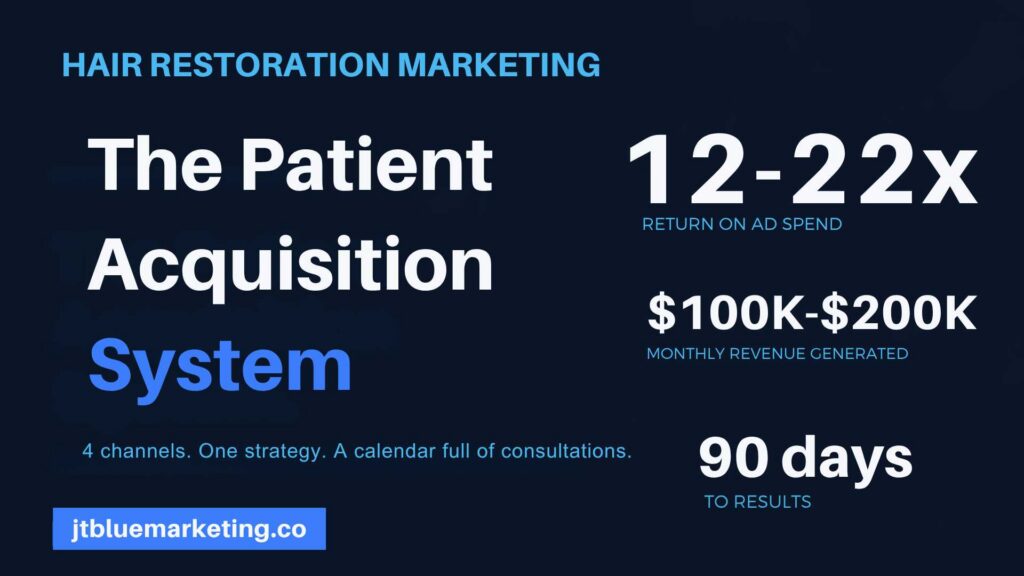
One of our facial plastic surgery clients, who we also apply this strategy for, before working with us were spending $8,000/month on google ads. They’re a pretty well known large agency but they were struggling to book consultations. When we came in, we rebuilt their Google Ads account with procedure-specific campaigns, restructured their landing pages around the patient’s research journey, and added a retargeting sequence for warm audiences. Within 90 days, cost per consultation dropped and monthly revenue from our efforts went from $0 to $100,000–$200,000/month. Return on ad spend hit 12-22 times the ad spend. We still work with together, he’s a dear client and we’ve been able to transform his medical practice thanks to our efforts.
This was all possible thanks to our strategy, our understanding of the industry, and having someone that truly cared about their business. Not someone that just looks at a report and moves on.
What to look for in a hair restoration marketing agency
Not every hair restoration marketing agency understands aesthetic medicine and almost none understand the nuanced patient psychology of hair restoration specifically. When evaluating partners, ask three questions directly:
- Can they speak about results or revenue generated, not just traffic data or leads, but actual practice revenue attributable to their marketing efforts?
- Do they have experience running ads for medical practices and know about advertising restrictions?
- Will you be working with a senior strategist, or is your work handed off to a junior account manager or delegated overseas 30 days after signing?
The agencies that consistently deliver for hair restoration clinics are specialists in your industry, don’t treat you like a number and have the results to back it up.
What to look for in a hair restoration marketing agency
Not every hair restoration marketing agency understands aesthetic medicine and almost none understand the nuanced patient psychology of hair restoration specifically. When evaluating partners, ask three questions directly:
- Can they speak about results or revenue generated, not just traffic data or leads, but actual practice revenue attributable to their marketing efforts?
- Do they have experience running ads for medical practices and know about advertising restrictions?
- Will you be working with a senior strategist, or is your work handed off to a junior account manager or delegated overseas 30 days after signing?
The agencies that consistently deliver for hair restoration clinics are specialists in your industry, don’t treat you like a number and have the results to back it up.
Frequently Asked Questions
How much should a hair restoration clinic budget for marketing?
Most established hair restoration clinics allocate 8–12% of revenue to marketing. For clinics doing $500K–$1.5M annually, a realistic digital ad budget starts at $3,000–$6,000/month, with additional investment in SEO, content, and social media over time. The right number depends on your market, procedure mix, and growth targets.
What is the best marketing channel for hair restoration clinics in 2026?
Google and Meta ads deliver the fastest ROI by capturing patients already searching for procedures. SEO also provides the best long-term cost per acquisition once keyword rankings are established. The highest performing clinics combine the 3, Google and social media ads for immediate patient flow, SEO for compounding organic returns over 6-12 months.
How long does SEO take to generate patients for a hair restoration clinic?
Most clinics begin seeing meaningful organic traffic growth within 6-12 months of a consistent SEO strategy. Page 1 rankings for competitive local terms — “hair transplant [city],” “FUE hair restoration near me” — typically require 9–12 months depending on market competitiveness and the starting authority of the domain.
Do Facebook ads work for hair restoration marketing?
Yes, very much so! Particularly for building awareness during the long research phase and retargeting warm audiences. Cold Facebook traffic for hair restoration converts best with patient journey video and educational content, not direct promotional ads. Compliance with Meta’s healthcare advertising policies (no before/after in certain placements, no guaranteed results, avoiding certain words) is essential to stay compliant and see success.
What makes a hair restoration marketing agency different from a general digital marketing agency?
Aesthetic medicine has unique advertising restrictions, patient psychology, and conversion dynamics that general agencies don’t understand. We’ve seen this first hand ourselves. A specialist has a proven process, knows which claims trigger Google and Meta disapprovals, how to structure campaigns around the hair restoration patient’s research journey, and how to create content that converts high buying intent patients into booked consultations.
How do I get more hair restoration patients?
Getting more hair restoration patients comes down to showing up at every stage of their research journey, which is longer than almost any other aesthetic procedure. The most effective strategy combines Google Ads to capture high-intent patients actively searching for procedures, SEO to build organic visibility over time, and social media content distribution ads that build trust and credibility before they ever contact your clinic. Retargeting warm audiences on Meta (people who’ve already visited your site or watched your videos) consistently delivers the lowest cost per lead. The practices that fill their calendars aren’t necessarily spending the most. They’re showing up consistently across every channel their patient is spending time on.
How do I advertise hair restoration on Google without getting disapproved?
Google doesn’t allow certain keywords, such as PRP, to be used in your ads or to be included on your landing page. Having them will immediately triggers ad disapprovals. To stay compliant, also avoid making efficacy claims you can’t substantiate, steer clear of before-and-after language in ad copy, and ensure your landing pages don’t contain restricted content even if the ad itself is clean. Working with an agency that has experience running hair restoration Google Ads and has already navigated these restrictions across multiple accounts significantly shortens the time between launch and capturing your first qualified lead.
For more information, contact us or email us at josh@jtbluemarketing.co.
Let’s Talk About Your Growth
Contact us for a free consultation and let’s build a custom healthcare marketing strategy that fits your practice.
Book a Consultation
It’s easy and free!
Tags:Template2

Josh Torres
CEO & Founder, JT Blue Marketing
With a proven track record of generating millions in revenue for clients, he focuses on strategies that deliver ROI and position practices as industry leaders. His approach is clear, data-driven, and tailored to each practice’s unique goals.